Bali is amongst the world’s most famous honeymoon destinations. However, this charming island has a lot more to offer than just mere beaches and pubs. Indeed, Bali and Indonesia offer a perfect mix of natural beauty, rich culture, and extremely hospitable people. There is so much to see and experience that people can travel for a week or two or even longer without getting deja-vu. And of course, the weak Indonesian Rupiah and multiple local low-cost airlines such as Air Asia, Malindo Air, and Lion Air make this a relatively inexpensive vacation.
We traveled to Bali and Yogyakarta (popularly called Jogja or Jogjakarta) with our family for a week in July 2017 and couldn’t have asked for a better holiday. We were not looking for a ‘beachy’ vacation, and instead were more intent on exploring the local Indonesian culture. We will detail our itinerary and other options to suit various tastes.
General tips:
– There are a lot of options to stay in Bali, most of which are very affordable. Apart from hotels and beach resorts, multiple affordable well-equipped picturesque villas are available on Airbnb (we chose the latter). Take your pick!
– As a general overview, staying options in Bali would usually include an along the coast city to experience the beautiful beaches, and Ubud, to get a flavor of their world-renowned art. Kuta is the main central beach hub, close to the airport and where the party scene and night life is the most happening; but expect more crowds the closer you are to Kuta.
– Bali being a relatively small island, one can actually stay put at one place and travel the whole island with day-trips as well. While there is a lot to explore, our vote for the minimum must-do places beyond beaches would include Uluwatu temple, Tanah Lot temple, Ubud, and Ulun Danu Bratan temple.
– Most temples etc in Bali do not offer guides or helpful signboards to explain what we see. It is better to check online to get at least a basic understanding about the temple and its history. Guides are easily available in Yogyakarta.
– While a lot of tour operators are easily available online, a relatively cheaper way to travel is to book a car and driver for the entire day/ trip. The standard rate is around 450-600k IDR for 10 hours, and 50k IDR per extra hour per day. An online search will provide numerous such drivers who respond quickly to a simple whatsapp message. We ourselves traveled with Adi (contact no: +62 82147597237, website: www.waisnawatour.com) who was a really nice and reliable guy; we would certainly recommend him
– Traffic is baaaad; there are huge snarls due to the lack of a highway system and it takes a long time to travel short distances especially in the evenings.
– Bargaining while shopping is fair game in Indonesia. Quote a price which is at least one-fourth or one-third of what is offered by the seller and take it up from there.
– While Bali is of course amazing, the most traveled destination in Indonesia (and the highlight of our trip) remains Borobudur in Yogyakarta. There are also other beautiful destinations such as Lombok and Mt Bromo. Check them out, and decide your rough itinerary accordingly before booking your flight.
– Veg food is easily available in Bali; but options get limited in other cities.
As usual, we are sharing our itinerary on our google maps page. Here is the link: https://drive.google.com/open?id=19SJaI5kG6-Ad6l3pJR5xsYbg-d4&usp=sharing. Select the labels ‘Bali’ and ‘Yogyakarta’.
We are replicating our itinerary which amounted to 5 days in Bali and 2 days in Yogyakarta.
A. Bali
Day 1: Kuta
After landing in the afternoon and checking in to our cozy villa in Seminyak, we spent the evening enjoying the sunset at Kuta beach and then exploring the local market and getting a feel of the place.
There is a wholesale shop called Geneva in Kuta that has an good collection of handicrafts at great prices under one roof and can save you a lot of time.
Day 2: Uluwatu temple and GWK park day-trip
We explored south Bali today. We first headed to the GWK park (Garuda Wisnu Kencana), which boasts of being the site of construction of the world’s largest Vishnu statue, due to complete in 2018. It also has a beautiful statue of Garuda and an amphitheater which offers hourly traditional Balinese dance performances with a different dance every hour. We enjoyed two of them (Nusantara and the Barong dance). GVK was worth the price as we would have anyway bought a ticket just to see the Barong dance performance elsewhere. We spent around three hours at GVK enjoying the dances and having lunch.
We then headed to Uluwatu, stopping for a while for tea and coffee tasting at a luwak coffee plantation just before Uluwatu. Luwaks are animals which eat the coffee cherries and excrete the beans; the coffee is extracted from their excreta (yes; you are reading this correctly!) to make Luwak coffee. You will find these across Bali, and the coffee was not bad at all (we admit it would have tasted better though if we did not know how it was made!).
Uluwatu is a temple dedicated to the sea God Baruna (nine such temples were built along the Bali coast as a homage to the sea God, Tanah Lot being another example). It is unique in that it is perched on a cliff for some beautiful views and photo-ops, particularly if you catch a good sunset (aim to reach an hour before sunset). Beware of the monkeys here; they enjoying grabbing any eatables, cameras and glasses from tourists.
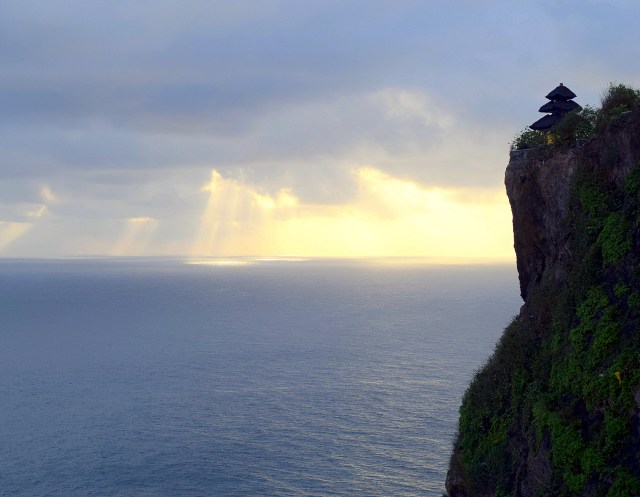
Uluwatu at Sunset
There is a Kecak dance performance held at Uluwatu everyday at sunset (6-7 pm), which is an interesting experience. Unlike other Balinese dances, Kecak is not accompanied by musical instruments and a group of 60-70 singers in chorus give the background ‘music’. The dance is based on the Hindu epic Ramayana; reviews are mixed but it is certainly an interesting experience and one that both of us enjoyed. Tickets are priced 100K IDR and can be bought on the spot at the temple.
Places we skipped but that can be done on this route are the Pandawa, Jimbaran Beaches and the Turtle Island (poor reviews on Tripadvisor for the Island; 2 stars).
Day 3: Ulun Danu Bratan temple – Ubud
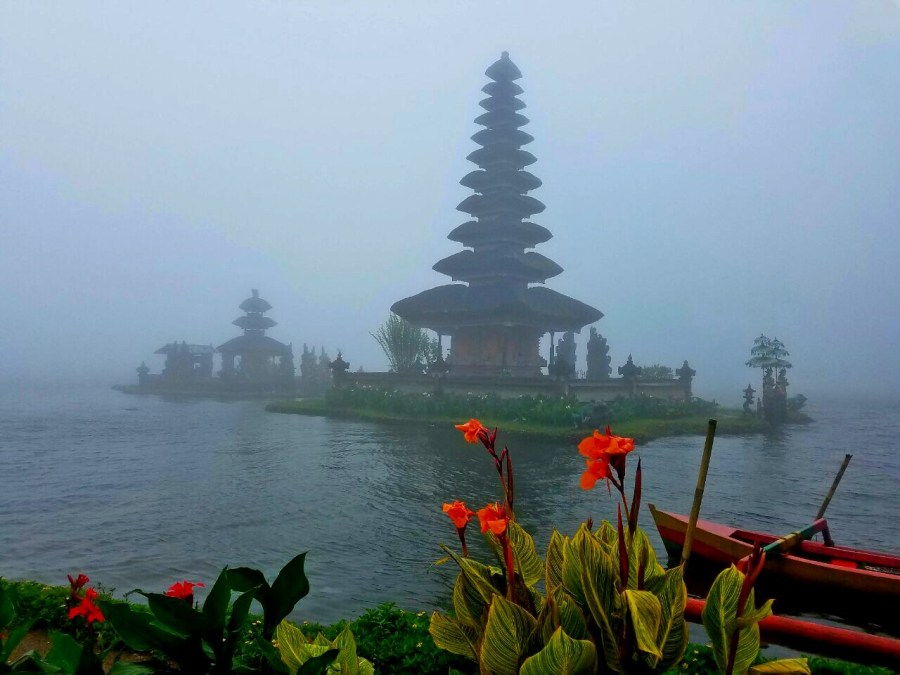
We checked out and headed to Ulun Danu Bratan temple, a 2 hours drive. Ulun Danu is in the rainforest zone and at a height, so expect some rainfall and cooler temperatures and prepare accordingly. It is a beautiful temple along the lake (picture below), and one of our favorite experiences in Bali.

Other places on this route are the Twin Lake view point, a visit to the botanical garden to experience tropical rainforest vegetation, and Gitgit waterfall. We ended up skipping these as it was raining heavily. This day trip can be combined with the Jatiluwih rice terraces along the way; they are amongst the largest rice terraces in Bali with less visitors and hawkers than the more conveniently located Tegalallang rice terraces near Ubud. While we did not go there, we did see some beautiful rice fields along the drive (photograph below). Depending on the tide, one can also go to Tanah Lot before traveling to Ulun Danu (but we would recommend being there for sunset time if possible).
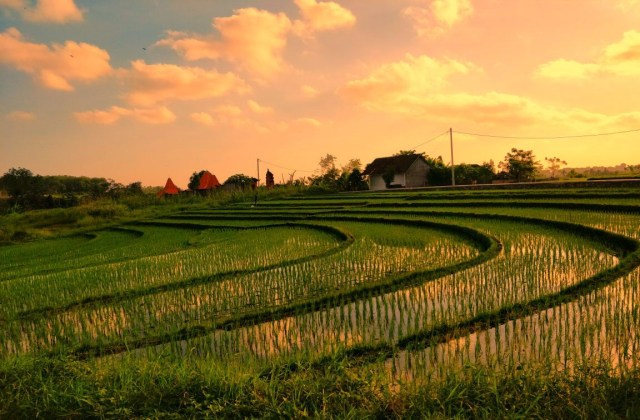
Ubud is a beautiful town in central Bali and the epicenter of traditional handicraft making in Bali; making it a shoppers’ delight and a cultural hub, with tastefully decorated restaurants and boutiques. The entire town is like a one huge art museum. Local tourist spots include the Ubud Palace (free entry) and the Monkey Forest (precisely what its name implies; hundreds of monkeys in a small ‘forest’); neither takes much time to see. We really enjoyed exploring the market in the evening.
Day 4: Tegalallang – Kitamani village (Mt Batur volcano view) – Ubud
We headed out to Kintamani Village for the view of Mt Batur. We then drove to the Tirta Empul water temple, a temple where people often have a bath in the holy water. We thought these two places was skippable and would have saved us the long drive and half a day.
We enjoyed the beautiful Tegalallang rice terraces (picture below) along the way though. The Tegalallang market offers better and cheaper shopping options- definitely a must-visit.

Multiple sunrise trekking tours to Mt Batur are available from Ubud for those interested. Another en route sightseeing option which we skipped is the Gunung Kawi temple.
Day 5: Artisan Ubud villages – Tanah Lot temple
We checked out of our villa and traveled towards Tanah Lot temple. We stopped at numerous local villages along the way where various local arts and handicrafts originate. These include Mas village for wooden sculptures, Celuk village for gold and silver smiths, Batuan village for extraordinarily beautiful artwork and paintings, and Batubulan village for batik weaving. Batuan has an extremely high-quality co-operative art gallery housing 150 painters which displays their works, and where they also act as guides to explain paintings to the tourists. Although extremely expensive, the paintings were exquisite and we would certainly recommend stopping over. You would also find numerous smaller local shops selling interesting paintings and artwork, and we ended up purchasing a few of these too.
We then headed to the royal temple (Taman Ayun), which is a nice half hour stopover, before heading to Tanah Lot temple. Tanah Lot is a beautiful temple along the coast (google image it!), which is accessible for entry only during low tide. Exquisite views and photographs can be obtained during sunset time, and this is pretty much a must visit for anyone in Bali. We stayed in an excellent airport hotel at night (Radiant hotel and spa: provided free airport shuttle and packed breakfast for the flight; recommended) to catch our early morning flight to Yogyakarta the next day.
Other options for things-to-do in Bali:
Our itinerary was less traditional in the sense that we did not do many ‘beachy’ things on our trip. Other common options for Bali include:
a. Snorkeling and scuba diving: Multiple options exist, including Nusa Dua, the Nusa islands, Menjangan Island, Padangbai, and Amed, amongst others. Distance from Kuta may influence the choice. A few helpful links to decide are below.
https://indonesia.tripcanvas.co/bali/snorkelling-spots-in-bali/
http://www.bali-indonesia.com/magazine/5-best-snorkelling-beaches.htm
b. A day trip to the beautiful island of Nusa Penida.
c. White water rafting on Ayung river.
d. Enjoy the famous Balinese spa and massage experience. (Karsa Spa and Jaen’s Spa are the highly recommended ones).
Food options in Bali
We were able to get good vegetarian food at many places. Here is a list of some of the good restaurants we went to.
– Queens Tandoor: Easily the best Indian food in Bali, it has many branches. We went to the one in Seminyak. Expect long wait times though.
– Earth café, Ubud: Good vegetarian and vegan options.
– The Elephant, Ubud: Excellent food; try to book in advance though.
– Other veg places which we did not end up going to but offer good veg food as per reviews include Ganesha-Ek Sanskriti (Indian food chain) and Zula vegetarian paradise (Seminyak), among others.
B. Yogyakarta:
-For car-rentals, we found this site very helpful https://www.yogyes.com/en/yogyakarta-transportation/car-rental/car-driver/. The approximate cost per day for a SUV is around 550,000 IDR inclusive of parking and tips. Definitely ask for a English speaking driver before you finalize.
– We stayed at Hotel Grand Aston and we were thoroughly impressed by their hospitality and the elaborate breakfast with a lot of local preparations (please give yourself close to an hour to enjoy the breakfast!)
-The best place to shop Batik in Yogyakarta is undoubtedly the Malioboro street. A place called Pasar Beringharjo has some good shops to buy Batik art and handicrafts and we were told that the prices here are lower than elsewhere.
Day 6: Yogyakarta: Ulen Sentalu museum and Prambanan temple
We caught an early morning flight from Bali to Yogyakarta. Since we gain time en route, we landed as early at 8 am. The view of Mt Merapi (a volcanic mountain) from the flight is great; recommend catching a window seat.
Since we landed early, we went straight to the Ulen Sentalu museum, a beautiful museum on Javanese culture, located about 45 min away from the airport. The ticket comes with a one hour guided tour, and it gave us some great insight into the history and culture of the Javanese people and royal family. This can be clubbed with a Mt Merapi jeep tour (around 2 hours) which takes you to some burnt homes and buried villages and to points with great views of the mountain. The ride is supposed to be rather jerky, and we skipped it. Sunrise treks are also available for those interested.
We then drove back to Yogyakarta, had lunch, and checked into our hotel to freshen up. We then drove to the Prambanan temple complex. This is one of the largest Hindu temples in south-east Asia and is a must do; the photos speak for themselves about its beauty. Hiring a guide is recommended and they cost around 100K IDR. The temple looks extraordinarily beautiful against the setting sun, which is how you should time the visit. Sunset at the nearby temple of Ratu Boko is also supposed to be extremely beautiful, and many people do explore Prambanan and then head to Ratu Boko to catch the sunset. We however skipped that and have no regrets about it. We retired early to bed that evening to be ready at 3.30 am for the much awaited Borobudur sunrise experience. Visit http://borobudurpark.com/en/home-2/ for various ticketing options. The sunrise tour at Borobudur however is only through Manohara Hotel and you can get more information here: http://www.manoharaborobudur.com/packages/borobudur-sunrise.htm
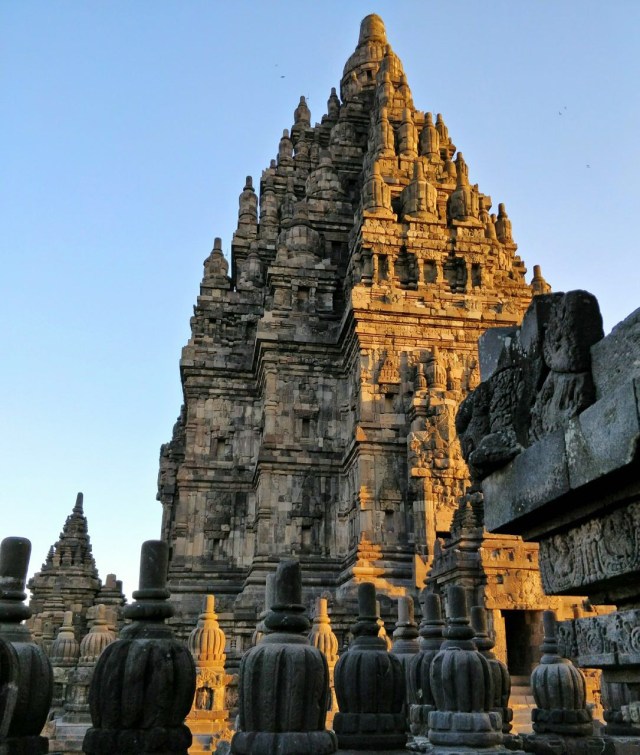
The Shiva temple at Prambanan at sunset
Day 7: Sunrise at Borobudur – Yogyakarta city tour
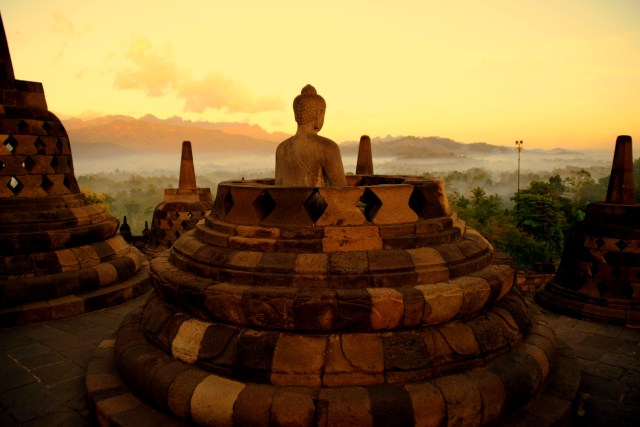
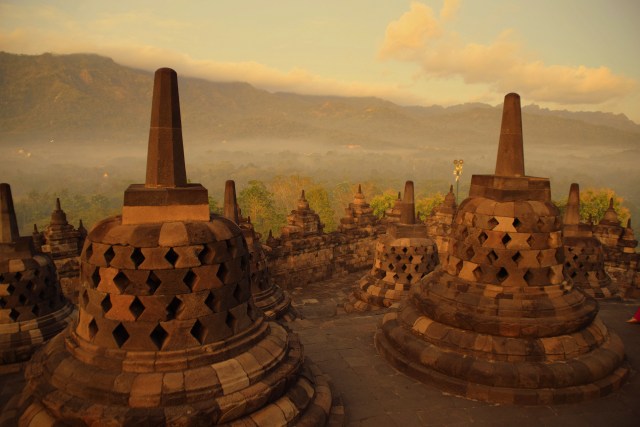
Borobudur is the world’s largest Buddhist temples, and while it is bound to be an awe-inspiring experience irrespective of the time of the day you go there, the sunrise experience at Borobudur is just spell binding. One does not need to pre-book; tickets have to be purchased at the counter at the Manohara resort. The cost of the ticket is around 35USD. You need to leave your hotel at around 3.30 am and reach Borobudur an hour later. Manohara provides you with a complimentary torch while going up to the temple as also a light snack after coming back down.
The beauty of Borobudur is not just the temple with its 500 plus Buddha statues and the perforated stupas housing many of them, but also the extraordinary mist in the hills and forests in the backdrop at sunrise time, which gives it an almost surreal feel. The regular cheaper tickets give entry from 6 am, and some people plan to use these and run up to the temple top and get a good view; but we would advise against it. While the sunrise time when we went was 5.50 am, dawn begins much earlier and it was actually pretty bright by 6 am; the views we had were absolutely unmissable and our photos barely do justice to them.

We subsequently had breakfast and then headed to the City Palace. You can get a local ‘guide’ for 20-30k IDR; this ‘guide’ shows you through the palace and then also takes you to a local Batik art/wall hanging shop which is ‘incidentally open only on that day for you to buy stuff if interested’. The Batik art in the shop is beautiful, quite reasonable and authentic; you should not give in to the pressure by your guide but don’t hesitate to buy something if you really like it (after haggling it down of course). We then went to the Taman Sari (Water Castle) which we do not recommend and the bird market (our son loved watching birds and pet animals, but probably not all that fun if you do not have kids). We then went to Malioboro street for its famous Batik shopping, before returning to the hotel for a well-deserved nap.
We went to the Ramayana Ballet at Mandira Baruga in the evening. This holds the Guinness record for the longest running continuous daily show, but is a bit pricey at 300k IDR (around 22.5 USD) without dinner. The ballet is relatively simple without any grand sets and does not justify the price of the ticket. They do provide free hotel pick-up and drop, making the experience otherwise convenient. Being Hindus from India and having seen the Ramayana multiple times, we did not find it worth the price, but the perspective may be different for someone else. Another option is to go to the Ramayana ballet at Prambanan temple at 7.30 pm; it is not a daily show however and there were no performances on the two days we were in Yogyakarta (it runs on Tuesdays, Thursdays and Saturdays as we write this). Pricing has cheaper options at Prambanan and it appears to be grander as per the reviews. The link to their schedule is here http://www.tourjogja.com/read/14/ramayana-ballet-at-prambanan.html
Food options in Yogyakarta:
Veg options are not plenty; but the ones mentioned below serve genuinely delicious food.
– Indian Cuisine: Taj Indian Kitchen: Excellent food; we loved it so much that we went there twice. It helped that it was walking distance from where we stayed.
– ISKCON temple: We had dinner here on our way from Prambanan to the hotel. The ISKCONites went out of their way to welcome us, and we got to eat warm puris and sabji right from the kitchen!
Non-Indian Cuisine: Loving Hut, Milas, SixSenses and ViaVia are supposed to be good as per reviews.
Day 8:
We flew back to Mumbai from Yogyakarta in the early morning with colourful memories of this absolutely beautiful country and with the hope that we shall return to explore all that we left for “next time”!
 Travelously yours
Hey Akshay and Trupti, that’s a great post, very informative as usual!
LikeLiked by 1 person