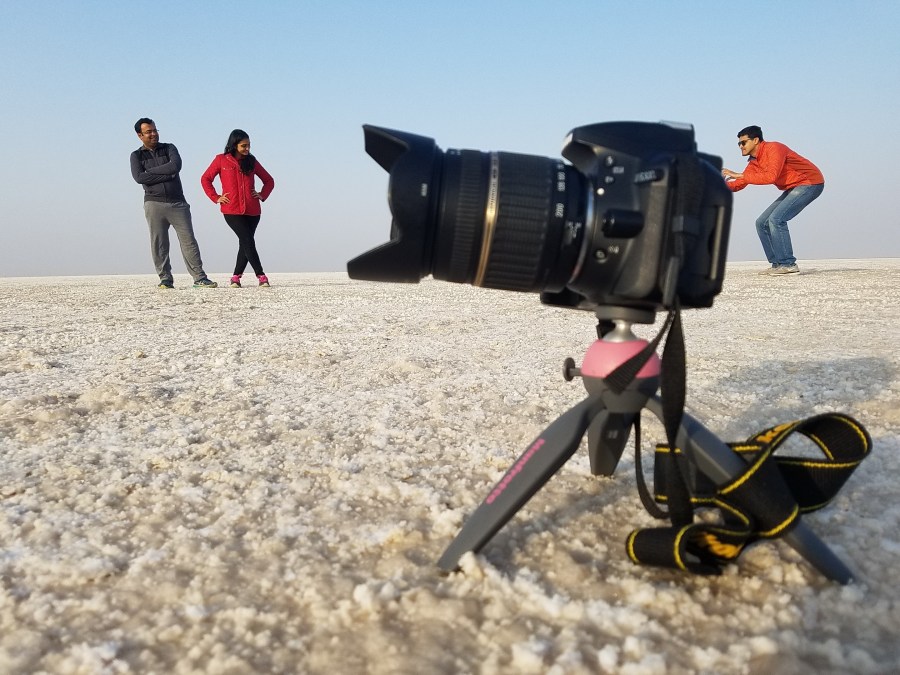
For a long time, we had been hoping to visit the Rann of Kutch, the world’s largest salt desert. Over a mid-January long weekend, we had one of the most exhilarating experiences at this vast land of nothingness! We went there anticipating only the great white desert and some great photo-ops, not expecting that the rich culture and diversity of Kutch would also leave us so spellbound.
What exactly is the Rann? The Rann is essentially a 10,000 sq km large ‘salt’ desert located predominantly in India. The most interesting thing about it is that it is underwater during the monsoon season (mainly Aug-Sept); the blue on the map is the salty Rann of Kutch lake, which becomes the Rann or the salt desert once the water evaporates after monsoon. The marshy land in the monsoon is also a haven for a multitude of migratory birds, and hence a bird lovers’ paradise.
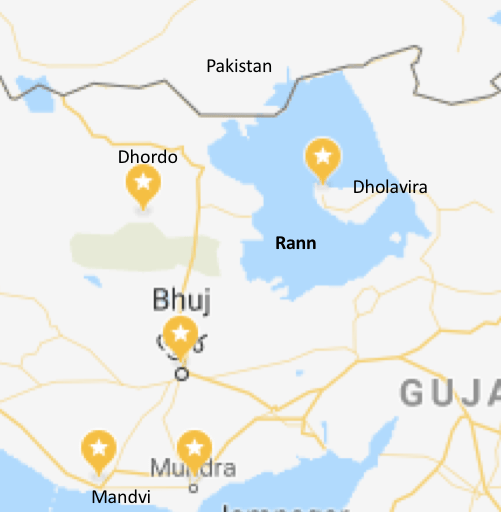
And what is Kutch? Kutch is a unique amalgamation of different geologies, ecosystems, and communities. It has the desert ecosystem of the Rann, the mangroves along the coast (along with beautiful beaches like Mandvi and huge ports like Mundra), and the Banni grasslands. In combination with its location along the border, different communities from India as well as other parts of Central Asia, Iran and Turkey migrated here, bringing with them varying crafts, arts, and traditions like block printing, bandhej, tie and dye, over 50 types of embroidery, mirror work etc etc. The colorful Gujarati attire is all thanks to the traditions of Kutch, with people having preferred to wear bright colors to get spotted from far in the arid conditions.
General Tips:
Closest airport/ station: Bhuj- There are two direct flights everyday (both from Mumbai) at the time of writing the blog, and several trains.
Total time needed: 2-4 days, depending on how much you wish to explore beyond the Rann. You could however stretch it longer as well.
When to go: Winter (Nov-Feb) for most, also the monsoon for bird-lovers. The Rann festival (Rann Ustav) is held by the Gujarat government for around 4 months in the winter (Nov-Feb), and is extremely popular.
Where to stay: It’s a toss up between the more popular Dhordo and more secluded Dholavira, as we explain ahead.
How to travel: We would recommend renting a car with a local driver; there are numerous such agencies operating in Bhuj and have pretty much comparable prices. The advantage of a local driver is that they know niches along the drive like local history, will know hidden places to catch a glimpse of cranes, storks and flamingos (one such example in the photo below), and have great suggestions on places to eat and shop.
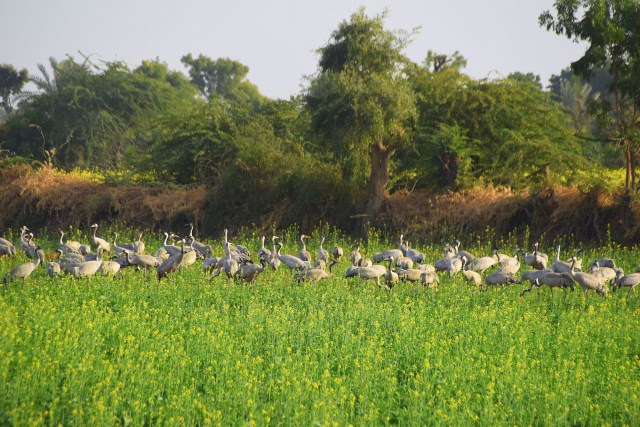
En route to Dholavira from Bhuj
We would highly recommend (in fact insist that you take him if available!) our guide-driver Mitul Jethi (contact no 9825234243); he was by far one of the best guides we have had, with in-depth knowledge, interesting local anecdotes and great humour which tremendously enhanced our experience.
As usual, we are sharing our itinerary on our google maps page. Click on the link. Select the label ‘Rann of Kutch’.
Things to enjoy
1. The Rann (of course!): The Rann is an experience words cannot describe. An infinite stretch of flat white desert makes a beautiful sight at sunrise and sunset, as well as converts to a star lit field for the star gazers. Being far away from the light pollution, you may be fortunate to witness the magic of lying down under the Milky Way. The full moon nights at the Rann bring many enthusiastic night photographers to capture unalloyed views of the moonrise over the silver desert. The afternoons are generally a bit hot and the salt gets mushy too with the sun right above; dawn and dusk are the best times to be at the Rann. Apart from the mandatory portraits and selfies and the ‘Jump together’ photos, it is also an ideal place to get some fun ‘forced perspective photography’ shots.


There are 3 places from where you can access the Rann easily: Dhordo, Dholavira, or at Ekal ka Rann. After reading and understanding the pros and cons of each, we visited Dholavira but we will give you a summary of all the three here.
a. Dhordo: By far, the most popular, the Gujarat government has developed Dhordo as the Rann’s showpiece. Multiple tent cities are set-up during the Rann festival, and one can get the ‘wholesome Kutch experience’ here. Local handicrafts, arts, folk dances and music make it very festive providing enough for the tourists to do in the afternoon and after sundown. The 1.5 hour drive from Bhuj to Dhordo has a several handicraft villages, where you can stop by and understand the techniques and intricacies which go into the making each Kurta or bag you had used.
-Nirona: famous for Ragan art
-Ludiya: also called ‘Gandhi nu Gam’, is an aesthetic delight with beautiful embroidery work and traditional furniture.
-Khavda Village: famous for embroidered handmade soft toys and leather
PERMIT: Given its proximity to the Indo-Pak border, you need to obtain a permit to go to Dhordo, but that is easily done either at the permit office (DSP Office in Bhuj or at the checkpost after Bhirandiyari village), or through your guide-driver or online here. Needless to say, this popularity of Dhordo and the festival is also its drawback, as there will hordes of people trying to share that vastness of Rann here. Another drawback is that all these tent cities are atleast 20-30 minutes away from the Rann and you need to take a vehicle or a camel every time you visit the Rann.
b. Ekal ka Rann is accessible through a village called Chobari. The Ekal Mata ka Mandir is the last point until where your vehicle will go, after which you will need to walk to the Rann. We were told that atleast parts of the roads to Chobari are mud roads and this place isn’t that well developed for tourists as yet in terms of accommodation and food. But if you have or if you do happen to visit Ekal ka Rann, we would love to know your experience.
c. Dholavira (our personal favorite): A 4-hour drive from Bhuj, this is as yet a relatively under-visited territory (fortunately!). Just before reaching Dholavira, there is an exquisite 7 km stretch of road that goes through the middle of the white desert and definitely goes into our list of the most beautiful (short) drives. This ‘umbilical cord’ connects Dholavira on the ‘island of Khadir Bet’ to the mainland during the monsoon.
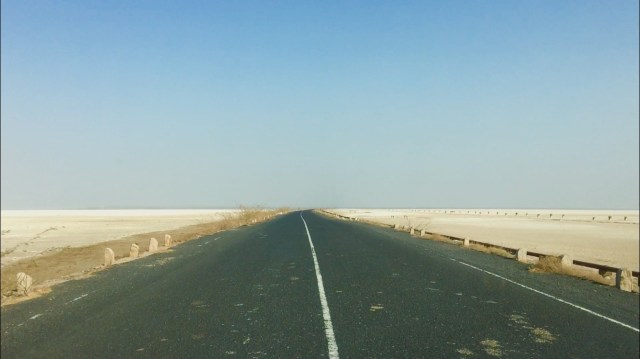
Driving through the endless Rann
We stayed at a new hotel called Rann Resort, Dholavira, with clean rooms. All the meals offered were lip-smacking home-made Gujarati delicacies and the hospitality which was exceptionally warm. (The resort also offers a jeep ride over the desert at an additional cost.)
The highlight of Dholavira is that the Rann is just in the backyard of the resort- we walked for a km into the Rann to reach the pristine white area we had only seen in movies. And once we got there, it felt as if we were the only people in this part of the world except for two others on their Harley Davidson who shared the Rann with us for less than 15 minutes! We spend several hours in solitude enjoying the feeling of littleness in the unending vastness. You must plan to see at least one sunset and sunrise here and don’t miss out on the night sky either.
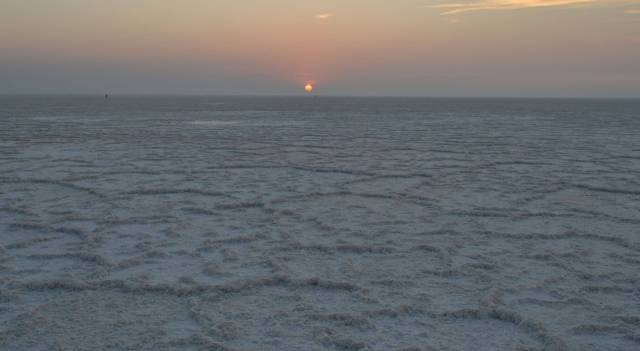
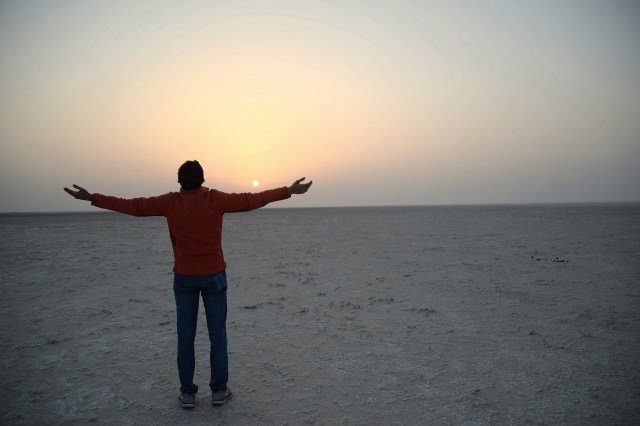
Besides the Rann, Dholavira also has two other unmissable things to do.
Harappan Civilization Site, Dholavira: This is the largest Harappan site after Mohenjodara and Harappa, and demonstrates a remarkably planned city dating back to (circa 3000-1800 BC). The 100 hectare ruins are an adventure in itself consisting of a Citadel (for the rulers and high officials), the Middle town, and the Lower town, with extra-ordinary water conservation techniques (including large interconnected reservoirs, underground water channels and reserves, circular wells, baths, and rainwater harvesting) and the only Harappan language signboard (yet undeciphered) to be discovered. Broken remains of Harappan era pots and crockery and terracotta necklaces are scattered as you walk, and it can easily take a couple of hours or more to explore the site if you let the stones speak to you! We would definitely recommend taking a guide (entry is otherwise free) and watching the short film at their tourist centre.
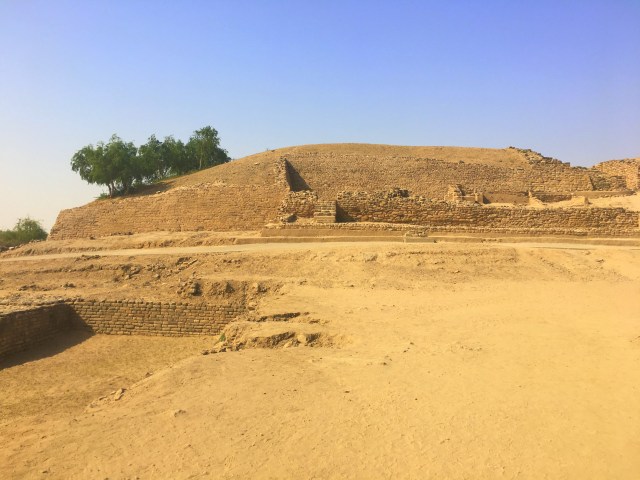
The Citadel
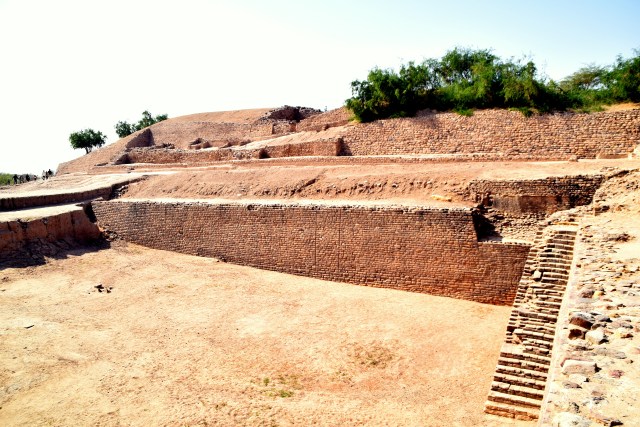
One of the multiple water reservoirs at the Harappan site
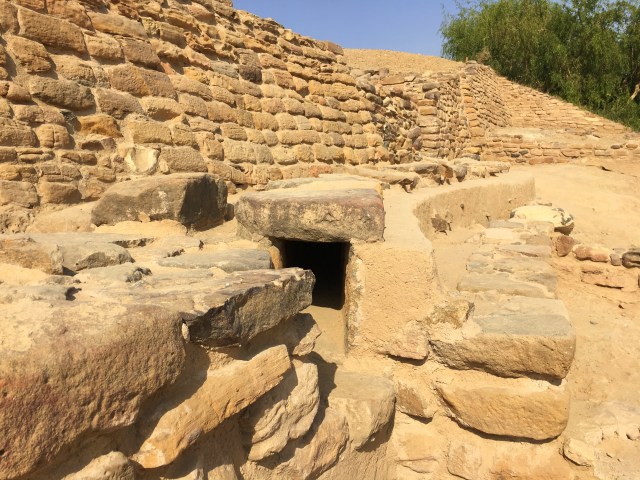
Advanced water drainage systems present 5000 years back!
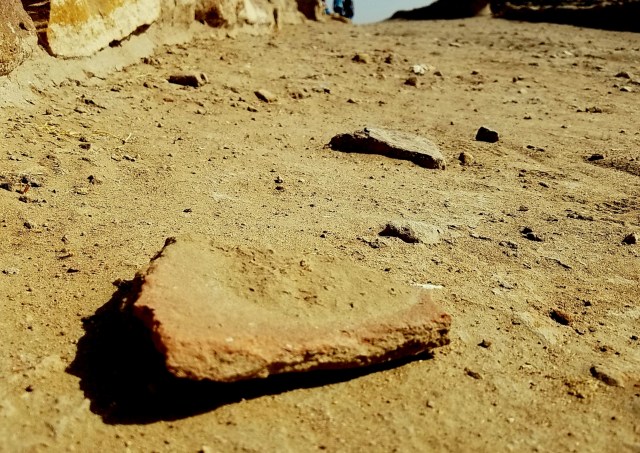
Ancient pieces of pottery, including ones more intact than this, are littered around!
Fossil Park, Dholavira: Also called the Wood fossil park, it has plant fossils from the Jurassic age (170 million years old!). Although they looked pretty awe inspiring, we wished there were some signboards explaining more details about them. The bigger attraction here though is an unhindered view of the Rann spreading across the entire horizon, as far as you can see. The photos below give you an idea of the monsoon view (taken from Wikimapia) and the Rann during winter.
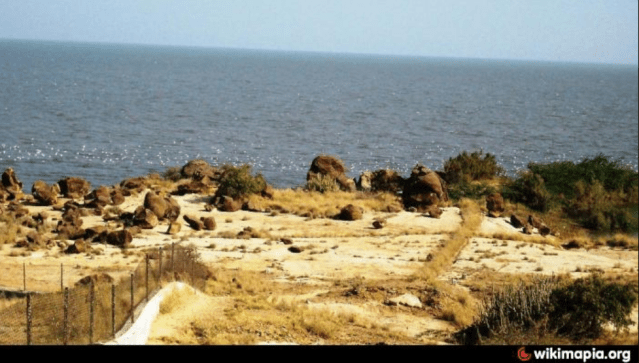
http://wikimapia.org/11286639/Fossil-Park-Gujarat-Govt#/photo/2468124 (during monsoon)
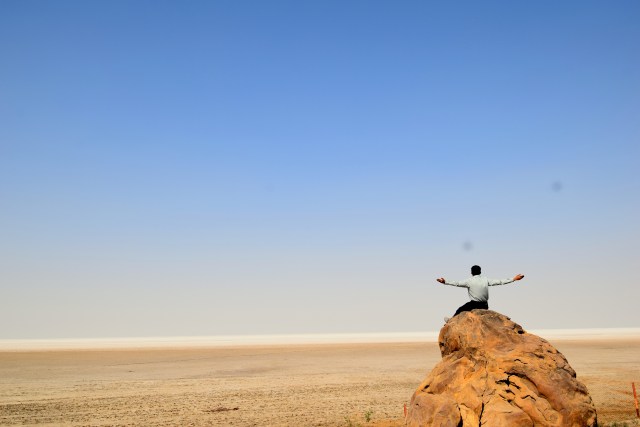
The Fossil Park and the vast Rann without the rains!
2. Bhuj: Bhuj hosts a beautiful Swami Narayan temple and a Trimandir (which houses idols of Gods of Jainism, Shaivism, and Vaishnavism). It also has terrific food (more on this later!), and is a convenient city for an overnight stayover.
3. Bhujodi, around 20 minutes from Bhuj, is a village which has evolved into a major textile handicraft centre. Over 1500 inhabitants being skilled artists in weaving, tie-die (Bandhej) and block printing, this is a great place to watch their craftsmanship come alive.
Another place of interest is the Bhujodi Vande Mataram Memorial; we skipped it but it has exhibits on the major episodes of India’s freedom struggle (such as the Dandi March) as also replicas of India Gate, the Parliament, and Red Fort. Its laser show is very popular and well-rated.
4. Ajrakhpur: We really recommend the Shrujan Living and Learning Design Centre in Ajrakhpur village which is a beautifully curated museum that has revitalized local arts and scientifically documented various forms of crafts – from textiles to pottery to metal, wood and stone craft. This place in fact gave us the perfect glimpse right at the beginning of our tour in Kutch and opened our eyes and minds for details and intricacies in lifestyles of the people we were going to see and meet over the next 3 days.
While in Ajrakhpur, drop by one of the block-printing workshops (the most famous being that of Dr Ismail Khatri’s), where you will be mesmerized by alluring patterns and vibrant colors of Ajrakh block print, a printing technique brought to this village from Sindh 400 years ago.
5. Mandvi: An hour’s drive from Bhuj (you can may spot crocodiles at the Khatri talab en route), Mandvi is a coastal town with a beautiful beach, the Vijay Vilas palace, and other little interesting tidbits to do. The palace is famous as the Hum Dil De Chuke Sanam palace. Although nice, we again sorely missed information plaques or a guide who could do justice to the palace. Also, we went there on a holiday, and the palace was literally swarming with tourists (hope you have better luck!). Another place of interest is the 72 Jinalaya temple, a beautiful white marble temple complex hosting 72 shrines for the Jain tirthankars, and a Jain pilgrimage site.
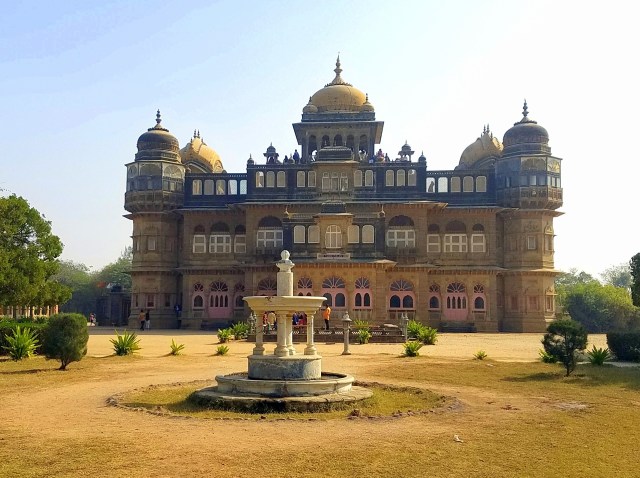
The Vijay Vilas Palace
What we really enjoyed was going to the ship building yard. There were at least three wooden ships being built, right next to a large flock of pink flamingos. We could climb onto one of them and enjoyed understanding details of the mammoth effort of crafting one ship over two years.
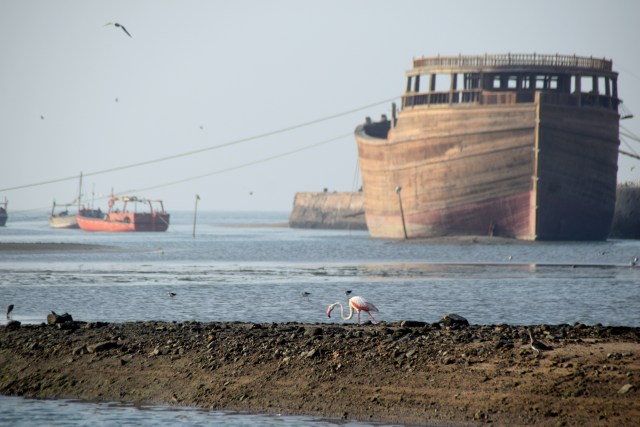
The ship building yards overlook large flocks of flamingos and other birds
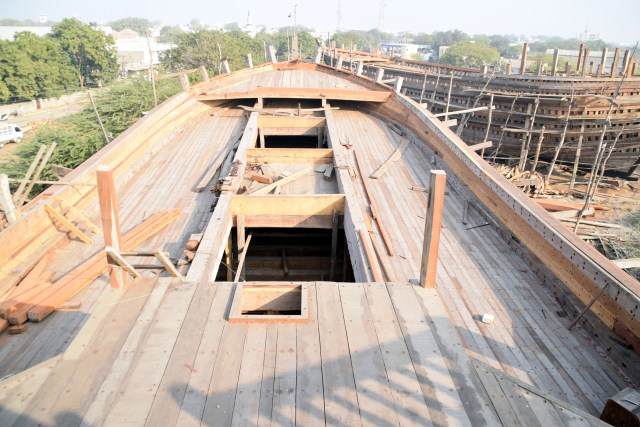
On a half-complete ship
The beach is also worth a look, with a lovely hue of blue! We were these on the kite flying day (Makar Sankranti), and there was quite some crowd, with the sky dotted with intermittent kites .
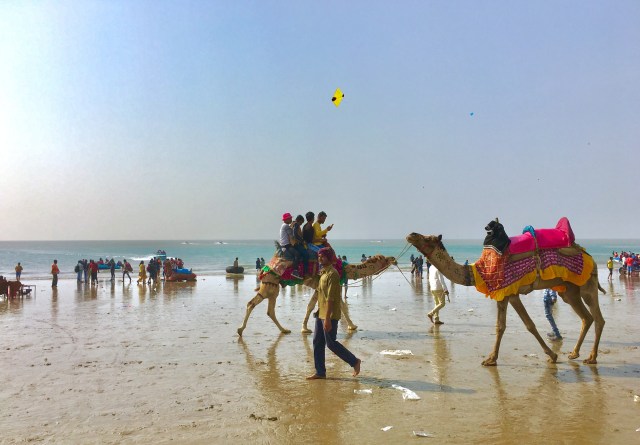
While in Mandvi (the birthplace of dabeli), don’t forget to try the spicy but delicious dabeli at Joshi’s stall near Nagar Palika Water Tank.
Food: Kutch is a foodie’s delight. The classic Gujarati fare of course also includes dabelis, jalebi fafda, khaman dhokla etc. The Hospital Road at Bhuj turns into a food paradise every evening and we recommend skipping a dinner in a restaurant and instead go stall hopping to try everything your eyes fall on. We particularly recommend the dabelis; there are three different food stalls selling their unique kinds and includes a classic one, a hara muttar (green peas) dabeli, and a bhel puri style dabeli. Try all of them! We also enjoyed a potato chaat sold in an icecream cone. Finish off with the out-of-the-world hot anjeer (fig) milk. Another must go place is the Khavda Mesuk Ghar sweet shop; the gulab pak is simply amongst the best sweets we have ever had, with other recommendations being the dry-fruit rich sweet adadiya and the savoury pakwaan. Over the next few meals, do try the local cuisine of (ghee rich) bajra ki rotli with gud (jaggery), khichadi- kadhi and gujarati thali.
Other options:
Mundra port: India’s largest and Adani’s flagship port is located an hours drive from Bhuj. This would be an interesting visit if you can land up a tour to demonstrate its working.
Monsoon visit for bird watching: Catch the Rann in a different wet avataar as it hosts numerous migratory birds during the August-September period. Another famous inhabitant is the wild ass, more commonly seen at the Indian Wild Ass Sanctuary at the Little Rann of Kutch.
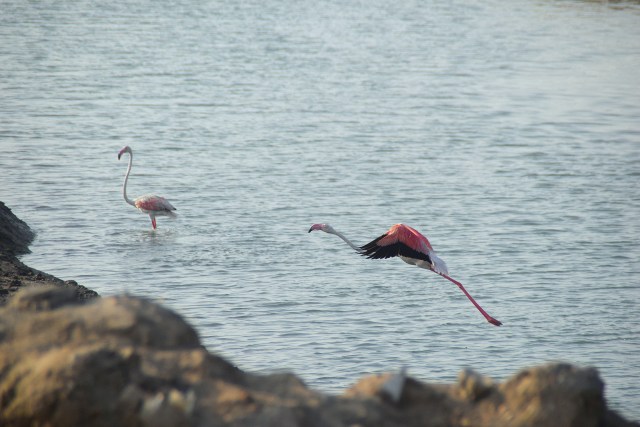
A flamingo taking off at Mandvi
Banni grasslands reserve: A 1.5-2 hour drive from Bhuj and an hour from Dhordo, these are a belt of arid grasslands at the southern edge of the Rann and, at 2500 square km, is Asia’s second largest belt of tropical grasslands and houses numerous animals and birds. The Chir Batti (ghost lights) is an unexplained dancing light phenomena known to occur in the banni grasslands, probably a phosphorescence phenomenon over marshy ground (Will o’ the Wisp in the West).
Our overall tour itinerary: We were able to go for 2 nights- 3 days. We landed early morning at Bhuj, had jalebi fafda at a local stall on hospital lane, went to Shrujan LLDC, and then carried on to Dholavira in time to catch the lovely sunset and the star studded night thereafter. We were back in the Rann for a magical sunrise. After a lovely breakfast, the rest of the morning was spent exploring the Harappan civilization site and the Fossil park, before heading back to Bhuj post lunch. We stopped at some block-printers on our way back (another option would have been to visit the Vande Mataram memorial), and then stayed at Bhuj for the night after a foodie trail on the Hospital Road. We spent the next day at Mandvi, where we went to the ship building yard, Vijay Vilas Palace and the beach before heading back to Bhuj for lunch. A quick temple trip later, we were at the airport munching on the Gulab-pak and agreeing with “Kutch nahi dekha to Kuch nahi dekha”. And as we took off, we promised ourselves (once again!), to be back in Rann soon, hopefully for a full moon’s night.
 Travelously yours
Wow.. Great pics.. I visited here last Mahotsav.
An interesting place to be added to above list is the Kala Dungar. It’s a bit crowded during the season but two points make it a must visit:
1. India Bridge – can be seen using binoculars/zoom lens of dslr. It has significance from Indo- Pak war times and looks good during the evening.
2. At foot of the Dungar, there’s a temple. The priest there offers food the jackals since decades. And the jackals visit every evening for the delight. Interesting sight to click.
Rest points you have captured beautifully. Indeed Kutch nahi dekha toh Kuch nahi dekha..
LikeLiked by 1 person
This was very helpful. I’ve been looking for someone who would help me have an overnight at Dholavira but all packaged did say trip from Bhuj!! I almost gave up as I’m adamant about having the overnight. Luckily found this blog and we called your guide now!
LikeLiked by 1 person
Thanks a lot for your lovely feedback Sirisha! Do let us know your experience once you complete the trip as well!
LikeLiked by 1 person